
Introduction to Highly Effective People
Highly effective people stand out from the crowd because they consistently achieve success AND they build strong, good relationships, not just any old ones. What sets them apart isn’t just a drive to win at all costs - lots of people are like that - but their genuine commitment to making sure that everyone involved in a situation can get something out of it. This win-win mindset - its at the heart of everything they do - is about creating situations where everyone wins, rather than having to be the one who comes out on top.
The habits of highly effective people - especially the one about always looking for the win-win - create a workplace & social environment where trust & collaboration really thrive. Because they always try to find solutions that work for everyone involved, they build relationships that are strong & productive - not just in their work, but in their personal lives too. This way of thinking about things can turn challenges into opportunities & competition into creative problem solving. When you adopt a win-win approach, you not only get what you want out of life but you also help others get what they’re after too - which leads to a cycle of ongoing & sustainable success.
In a world where way too many people still think that to win you have to trample all over someone else, highly effective people prove that the real choice is to go for outcomes where everyone ends up being happy with what they got. This is not just about being nice & going easy on people - its about laying the basis for achieving your long-term goals & having healthy relationships that support you.
Summary of Habit 4 of 7 Habits
Habit four is all about creating a win-win situation. Covey describes the significance of a win-win situation that leads to mutual benefit because if one side gets the edge over the other, it creates a win-win situation that is good for one side but bad for the other.
For the habit of highly effective people, he lays emphasis that win-win makes things cooperative instead of competitive because both parties are mutually benefited. Covey further explained that a win-win attitude has the outcome of three important character traits:maturity, integrity and an abundance mentality.
Covey, in this effective people’s habit, also explains that for a win-win, you not only have to be empathic but also confident enough; otherwise, the win-win situation might not be possible.
Human relationships are often dominated by comparisons and competition from the early years of our lives.
We think about succeeding in terms of someone else losing – if I win, you lose, if you win, I lose. It’s the mentality of fighting for a larger piece of the pie. But what if both of us could eat some of the pie and be fully satisfied?
This is what habit 4 thinks winning is all about – transforming life into a cooperative field instead of a competition using the best habits.
Think Win-Win

The idea behind “think win-win,” i.e., habit 4 is to have the courage to seek mutual benefit from all human interactions instead of having winners on the one side and losers on the other.
Achieving a “win win” way of interacting with others is more than just being nice or looking for a quick fix. A win-win solution isn’t easy.
When it is impossible to reach a win-win solution, you should suggest a “No Deal.” This has remained the habit of highly effective people.
What is Habit 4?
TThink win-win isn’t about being nice, nor is it a quick-fix technique. It is a character-based code for human interaction and collaboration.
Most of us learn to base our self-worth on comparisons and competition. We think about succeeding in terms of someone else failing–that is, if I win, you lose; or if you win, I lose. Life becomes a zero-sum game. There is only so much pie to go around, and if you get a big piece, there is less for me; it’s not fair, and I’m going to make sure you don’t get any more. We all play the game, but how much fun is it really?
Understanding Interdependent Realities
Mostly its our friendships at work, our family at home, or just general day to day interactions , that bring us our greatest highs and our biggest challenges. When we operate in situations where we need each other to succeed - which is more often than not - our success is all tied up with that of the people around us. Figuring this out is really key to adopting that win-win mindset which alot of us need to work on. Rather than thinking of life as a zero sum game where the one person wins and the other person loses, the really effective people I know understand that when we all chip in and work together great things can happen. That mutual benefit is the real way to lastingly succeed.
When you walk into meetings, or relationships or just general conversations with the idea that everyone involved has valid needs that should be taken into account, you open the door to new ideas and better outcomes. Thats what all this win-win business is about : balancing being brave and being considerate, and trying to find answers that take into account both your own needs and those of your colleagues, clients or partners. In situations where we need each other - and that is most of the time - its usually a bad idea to try and win at the others expense, because in the long run its a lose-lose all round - eroded trust, broken relationships and missing out on some real opportunities.
By accepting that we are all in this together, you shift your focus from competing with the other guy to actually working alongside them. You start to see that when you help others out they help you out too - and that your own success is actually boosted when your mates are doing well. Adopting this mindset means you can build stronger teams, more honest partnerships and a sense of shared accomplishment that is way more fulfilling than any fleeting win over someone else.
Why is Habit 4 so Important?
Habit 4 has a profound impact on the quality of your relationships. It helps build long-lasting trust that will make all interactions a lot easier.
It will bring more “luck” in your life, too.
In Covey’s terms, the Fourth Habit helps make deposits in the emotional bank account of the person you are dealing with.
Working with a mentality of abundance can change how you see work and life in general.
Rather than feeling envious of someone else’s success, you will genuinely be energized by it.
It takes conscious practice so start today :)
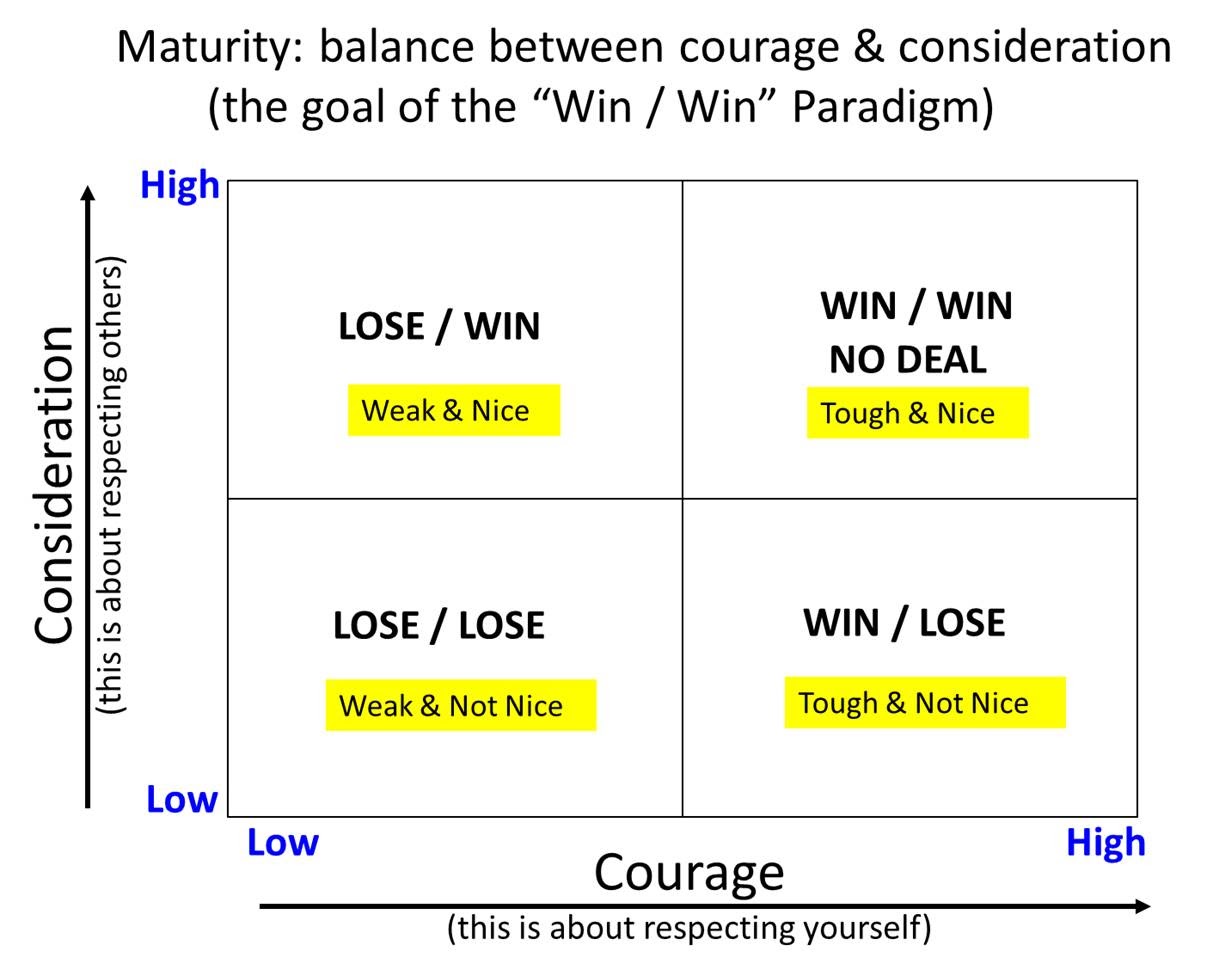
The Six Paradigms of Habit 4
The goal in habit4 is to think win-win and acknowledge the win-win paradigm as much as possible. It is important to identify when and how to use it for high productivity. Let us examine the six paradigms of habit 4 and how effective people use the right mindset to gain success in life:
1. The Win-Win: Everybody is Happy
The Think win-win resolution can be challenging and may seem impossible sometimes. It is the habit of highly effective people to engage in longer dialogues, even when it seems like you have reached the endpoint. Real maturity is listening to others carefully to comprehend their goals and perspective. It then follows by expressing your point of view. The end goal is to solve problems that neither party could have done on their own.
2. The Win-Lose: I Beat You
The Win-Lose paradigm concludes everything as a competition. It makes it seem that a person’s success must come regardless of the impact it may have on others. An authoritarian style is used by leaders who have a win-lose mentality. This mindset usually concerns authority, power, personality, or status to achieve what is desired.
Most people have an entrenched Win/Lose mentality reinforced through several life experiences. Schools, sports, and sibling rivalries are thought to be win/win examples of the win/lose paradigm. Although there might be situations where a win/lose approach is relevant, cooperation is a better approach than the competition.
3. The Lose-Win: You Win, I’ll Accept It
The people with the Lose-Win paradigm are inclined to move to the way of lesser resistance. They want to acquire acceptance from other people and are intimidated by others’ strengths. They shy away from expressing their feelings and wants. Leaders with this mindset or paradigm have an indulgent and permissive leadership style.
With this mindset, people suppress a lot of their emotions which can result in bursting out anger or resentment. Sometimes, it can affect the nervous, circulatory, and respiratory systems. Recognizing these situations is crucial for understanding the habits of highly effective people.
4. The Lose-Lose: Nobody Wins
When two people with a Win-Lose paradigm encounter each other, their attitudes can result in nobody winning. With such a mindset, an individual may be willing to take the hit to ensure the other person is losing. This paradigm results from getting so concerned about the fall of your opponent that you become blind to even your well-being.
You may develop a Lose/Lose paradigm if you are very dependent and have no personal direction. This means you think that if you are unhappy, then others should feel the same.
5. Win: Only You Win
A Win paradigm is different from a win-win or Win-Lose because it is concerned with only your outcome. If you possess a win mentality, you want to achieve your goals regardless of whether the other person loses or wins. It is the real alternative to the survival of the fittest mentality. It is the habit of highly effective people to take care of themselves, but you also expect others to do the same.
6. Win-Win: Valuing the Relationship
When it’s clear that two parties have entirely different goals, it can save a lot of problems to forgo a deal. The relationship can be kept healthy to collaborate on something different in the future.
With the win-win paradigm, you are inspired to find the right solution that benefits all the parties. If that doesn’t work, you can walk away from the deal, realizing that the two parties’ values do not align.
The No Deal option helps you pursue negotiation and will help you to consider that forcing a deal will only result in unwanted problems. Therefore, it is the habit of highly effective people to have no deal rather than having a conflicting deal.
Long-Term Success
The true power of the win win habit lies in its ability to create long-term, sustainable success. While a win lose approach might deliver quick results, it often comes at the cost of trust, goodwill, and future opportunities. Highly effective people know that the most valuable relationships and achievements are built over time, through consistent integrity, fairness, and a genuine desire for mutual benefit.
A win win mindset encourages you to look beyond immediate gains and focus on building a foundation for future collaboration. When people know you are committed to fair outcomes and value their needs as much as your own, they are more likely to trust you, support your goals, and seek you out as a partner. This leads to a positive cycle where everyone involved is motivated to contribute their best, resulting in greater creativity, innovation, and shared success.
Sustainable success is not about getting the biggest piece of the pie today—it’s about ensuring there’s enough for everyone, now and in the future. By practicing the fourth habit and thinking win win, you invest in relationships and solutions that stand the test of time, making you not just a winner in the moment, but a leader who inspires lasting loyalty and respect.
Key Takeaways of Habit 4
- A win-win situation helps to develop humility in you. If you rely on others for your success, it creates a sense of humility that enables you to find a mutual benefit situation.
- Win-win satisfies both parties because they believe neither of them is a winner nor a loser. This level of satisfaction enables them to work together in the future. In fact, it is the habit of highly effective people to achieve success by working together.
- The win-win strategy creates an atmosphere for both parties to find the solution that benefits them because if they don’t, one has to compromise for others.
- Win-win lets you identify humanity for others because when you become familiar with people who also have goals like you, it helps you understand them better.
- With win-lose, you can get the short-term benefit, but with win-win, you ensure that not you but the other party gets what they want, which makes both parties satisfied. The habit of highly effective people is that they want to succeed along with others.
- Win-win makes you assertive because it not only enables you to state what you want but also allows you to consider the needs of others. A prominent habit of highly effective people is to think of the needs of others along with theirs.
Conclusion on Habit 4 Think Win
Habit 4 is more than just a strategy to get ahead in life - it’s how you approach every single relationship and challenge with a fresh new attitude. Think of it as having a mindset that says: what if I could not only achieve my own goals but actually help others succeed as well? That’s when the magic happens - and suddenly you’re not stuck in that old win lose or lose win thinking, but instead you’re getting to benefit from an abundance of opportunities that come your way.
Highly effective people have figured out that there’s not really much of a choice between competing with others and working with them - in the end, the best idea is the one that makes everyone happy and fulfilled. By adopting a win win mentality, you not only end up loving yourself a little bit more, but you also build up a network of wonderful people who believe in you and want to help you grow and succeed. And that legacy of amazing relationships can keep on giving you more and more as time goes on.
As you move forward with this new mindset, just remember that it takes guts to be a true win winner - it means being brave enough to listen, really listen, to what others are saying, and having the courage to walk away from any deal that just doesn’t feel right. So make Think Win Win a core part of who you are, and you’ll find out what real success is all about - it’s not just about winning, but it’s about making sure everyone comes out on top.
7 Habits quiz
Many people know the theory but struggle with consistency — you can assess how well you apply the 7 habits with this quiz.
More Posts
Andrew Huberman's Productivity Routine: Hacks for Focus and Performance
Dr. Andrew Huberman is a well-known professor at Stanford University. He uses neuroscience to boost productivity. On his popular Huberman Lab podcast, he shares tips to improve your focus and brain power. He...
6 Golden Rules of Planning & Setting To Consider
Planning is vital to any successful project. The more you plan, the better your project will be and the less stress you will feel. However, planning can be quite challenging. Planning can be...
Week Plan Updates: Introduces Some More Great Features
What’s New in Week Plan 2.113.3?
11 Tips to Evaluate Students Progress Every Week
In online education, teachers face many challenges in checking how students are doing. Experts like Wendy Tietz and Tracie L. Miller-Nobles offer great advice on how to assess students better. They say it's...